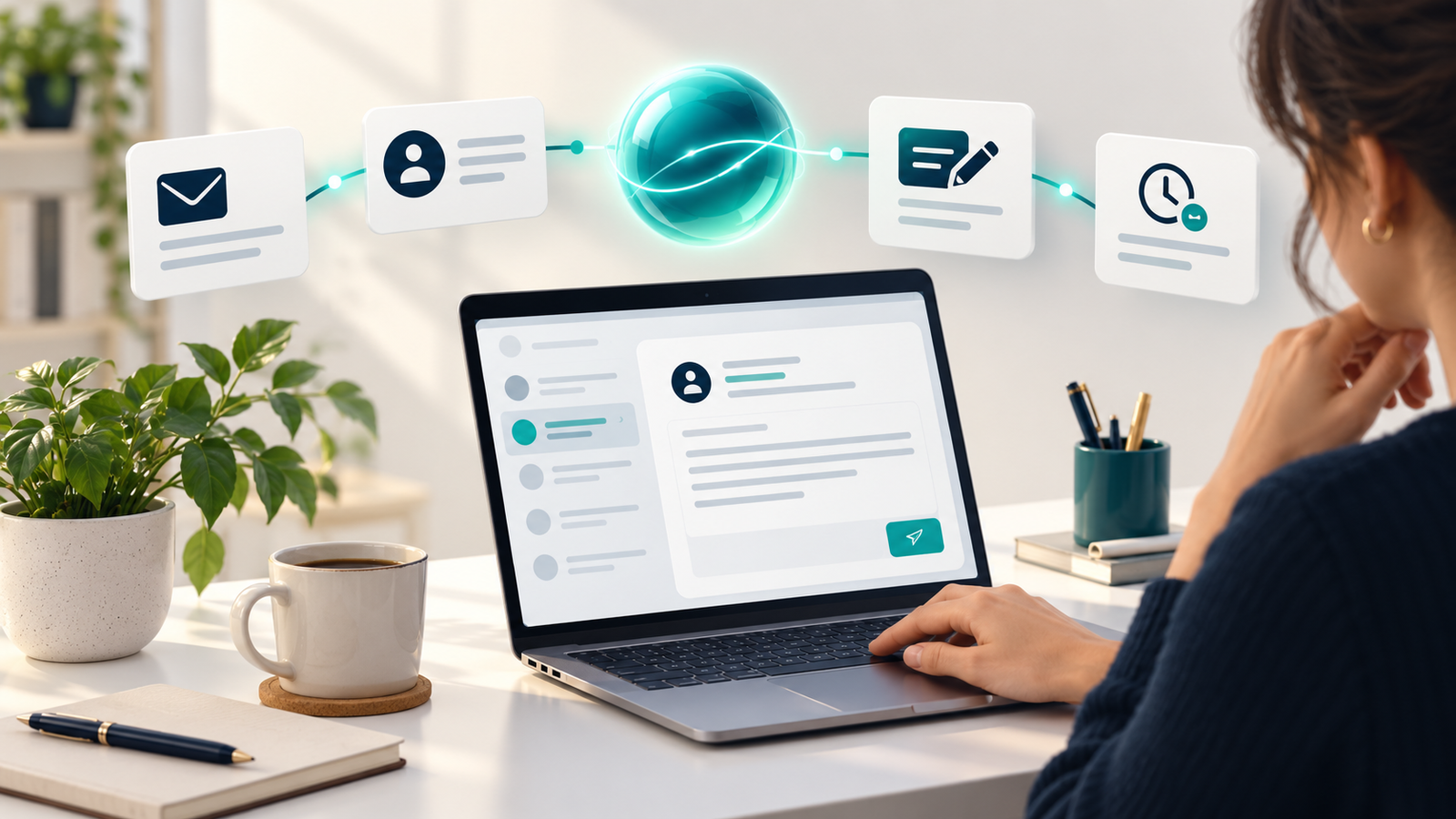
A customer sends an enquiry while you are working. Another asks for a quote through your website. By the time you check your inbox, you have several messages to answer and very little time to deal with them.
For a small business, attracting enquiries is only part of the job. The next challenge is keeping track of them and giving each customer a useful response.
This is where an AI agent can help — provided it has a clear task, reliable information and sensible limits.
What is an AI agent?
A chatbot usually answers questions in a conversation. An AI agent can also use connected tools to complete a sequence of tasks.
For example, a properly configured agent could read a website enquiry, identify the service requested, create a record in your customer management system and prepare a reply for you to review.
These capabilities depend on the tools and permissions available. An AI subscription alone does not automatically connect your website, email and business records.
Some steps also work better with ordinary automation. Moving a form submission into a spreadsheet does not necessarily need AI. Understanding a loosely written customer message and preparing a relevant response may benefit from it.
Why this matters in 2026
AI agents are becoming a practical option for work that involves several applications. Anthropic’s April 2026 publication, “Trustworthy agents in practice,” describes agents that direct their own tool use and highlights the importance of human control, transparency and appropriate access.
For a small business owner, the useful question is simple: which part of your enquiry process could an agent improve?
Start with a specific problem, such as missing messages or spending too long writing similar replies. That gives you something concrete to test.
Three useful ways to handle enquiries
1. Organise incoming requests
An agent could help sort enquiries by service, location or urgency, then flag missing information.
Imagine a cleaning company receiving this message:
“Can you clean our office twice a week?”
The agent could identify an office-cleaning enquiry and prepare questions about the address, office size and preferred schedule.
The owner would still decide whether the job is suitable and what to charge.
2. Prepare replies for review
Writing an initial response often involves repeating the same questions. An agent can prepare a draft using your approved service information and tone of voice.
For example:
“Thank you for your enquiry. Could you share the property location, number of rooms and preferred date? We’ll review the details and confirm availability.”
It should not invent prices, promise an appointment or claim that a booking has been confirmed.
For an initial pilot, reviewing drafts before sending them is a useful way to check quality.
3. Keep follow-up work visible
Enquiries can disappear into an inbox after the first reply.
A connected workflow could record when a quote was sent, identify enquiries awaiting a response and remind the owner to follow up. It could also prepare a follow-up message for approval.
Any automated sending needs clear rules about recipients, timing and when to stop. A customer who declines or asks not to be contacted should not keep receiving messages.
Keep control over business decisions
Give an agent access to the information it needs for its task. Define what it may do independently and what requires your approval.
For an enquiry assistant, useful boundaries include:
- Use approved information about services and availability.
- Flag uncertainty instead of guessing.
- Keep prices, discounts and commitments subject to the owner’s decision.
- Record completed actions so they can be checked.
- Provide a simple way to pause the workflow.
Customer information also deserves care. Before connecting tools, understand what data they receive, why they need it and how it will be handled.
How to test whether it helps
Start with one enquiry channel and one workflow.
First, measure your current process: how long replies take, how many enquiries need chasing and how much time you spend on administration.
Then test the assistant on sample enquiries before using it with real customers. Include incomplete requests, unusual questions and messages it should pass to a person.
During the pilot, track:
- Time spent reviewing and answering enquiries.
- Accuracy of the drafts.
- Missed or duplicate actions.
- Whether customers receive useful next steps.
Include setup, subscriptions and maintenance when assessing the cost. Faster replies are valuable only if they remain accurate and helpful.
Where should your business start?
You do not need a complete AI team to improve enquiry handling. A focused assistant that organises requests and prepares replies can be a sensible first project.
If your business receives very few enquiries, a good form, email templates and reminders may be enough. If messages arrive across several channels and require regular interpretation, an AI agent may offer more value.
AIProMarketing helps small businesses explore practical ways to improve websites, digital advertising and enquiry handling.
Based in Athlone, Ireland, we work remotely with businesses in Ireland and internationally.
Discuss your business with AIProMarketing.